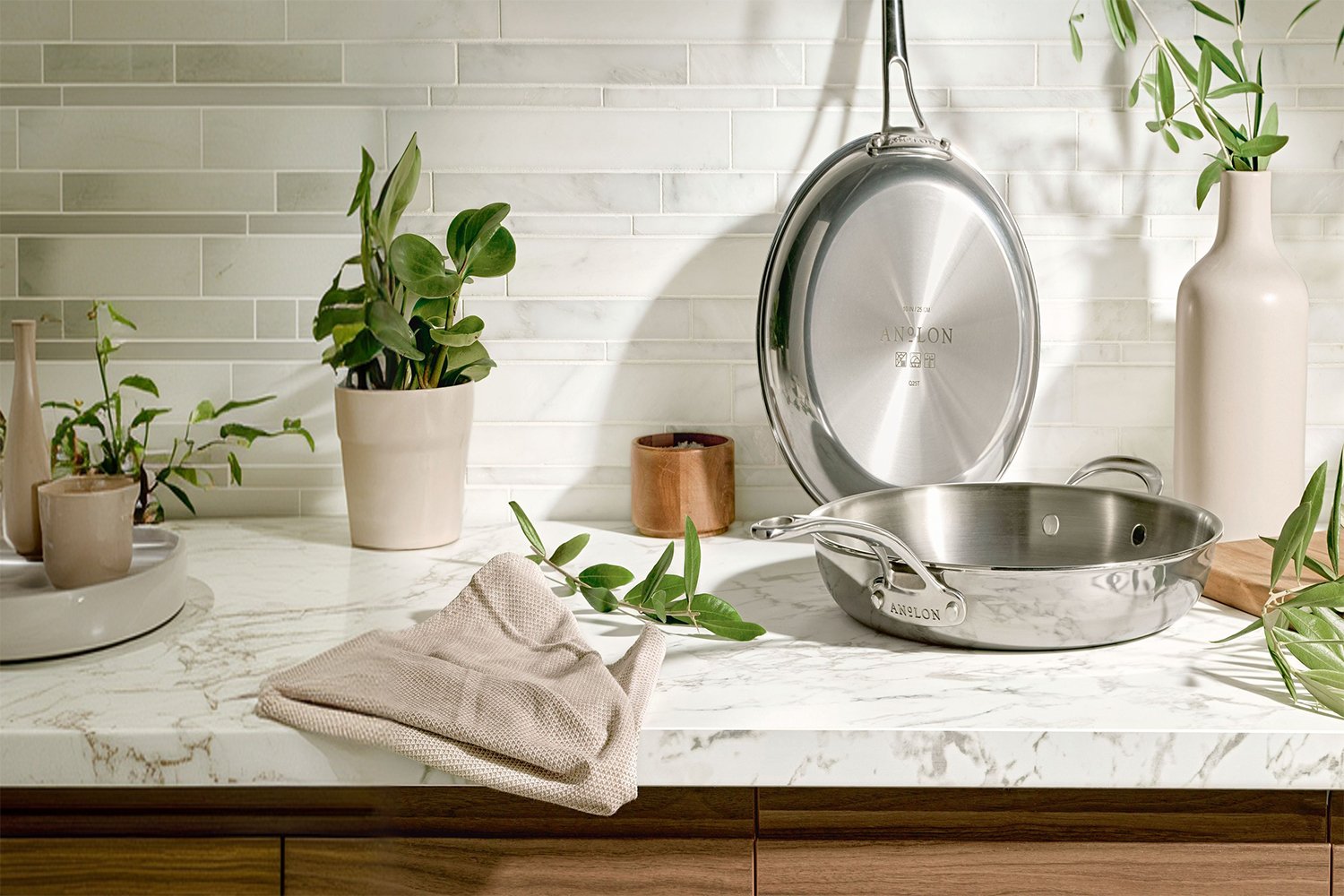
Nobody talks about Anolon the way they talk about Caraway or HexClad. There’s no viral moment, no celebrity deal, no color palette that took over Pinterest for three years. The brand has been around since 1987 and it has spent most of that time doing something increasingly rare in the cookware world — just making good pans and letting people who cook figure it out for themselves.
That strategy has worked out better than you might expect.
Hard-anodized aluminum — what it actually means
Most people buying cookware don’t think much about what the pan body is made from. Nonstick is nonstick, right? Aluminum is aluminum?
Not really. And this is where Anolon’s whole thing starts to make sense.
Standard aluminum is a soft metal. It dents. It warps at high heat. It reacts with acidic food. The nonstick coatings applied over it don’t have a particularly stable foundation, which is part of why cheap aluminum nonstick pans feel cheap — the base itself isn’t solid.
Hard-anodized aluminum goes through an electrochemical process that creates a dense aluminum oxide layer on the surface. The resulting material is harder than stainless steel, non-reactive with food, and smooth enough at a microscopic level that nonstick coatings bond to it far more thoroughly than they do to regular aluminum. The process was originally developed for aerospace applications. Calphalon brought it to cookware in the 1960s. Anolon was founded specifically to build on that technology.
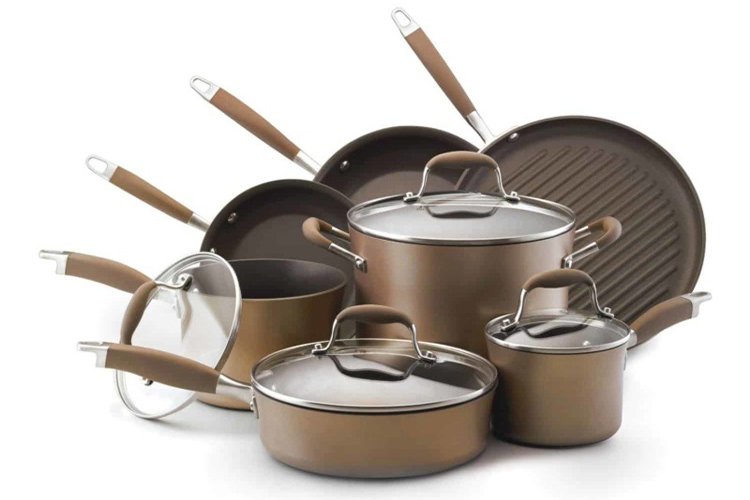
The practical difference shows up in durability. An Anolon pan will outlast a standard aluminum nonstick pan of similar price by a meaningful margin — not because of better coating alone but because the foundation under the coating is fundamentally more stable.
What you can actually buy
The range is wider than most people realize. Anolon makes several collections at different price points, and while they all share the hard-anodized base, the coating technology and design details vary enough that choosing between them matters.
Advanced is where most people start. It’s been around long enough that the design has been refined through multiple generations. Hard-anodized body, multi-layer nonstick, comfortable handles with silicone grip sections. These are the workhorse pans — nothing flashy, everything functional. For everyday cooking they perform consistently and hold up well.
Anolon X is different enough that it deserves separate mention. The cooking surface has a stainless steel mesh pattern embedded in the center of the pan. The idea is similar to what HexClad does — stainless contact points for searing and browning, coated areas around them for nonstick performance. Anolon developed this concept independently and the execution is solid. These pans handle higher heat than standard nonstick and can develop a real sear on protein. Not at the level of pure stainless steel, but meaningfully better than a flat nonstick surface.
Accolade sits at the premium end. Different coating formulation, claim of superior durability, higher price. For buyers who want the best version of what Anolon makes, this is it.
The culinary school connection
This is the detail that matters most if you’re trying to understand Anolon’s real-world reputation.
Professional culinary schools are brutal on cookware. Students learning technique handle pans roughly. Equipment gets used constantly, cleaned constantly, stacked incorrectly. Anything that can fail will fail — and schools are buying replacements regularly enough that cost matters alongside durability.
Anolon has found its way into culinary school kitchens through performance rather than marketing. Schools aren’t buying Anolon because of sponsored content or ambassador deals. They’re buying it because it holds up under conditions that destroy cheaper alternatives and doesn’t require constant replacement.
That’s the kind of product endorsement that’s genuinely hard to manufacture.
Day to day cooking reality
Heat distribution on a hard-anodized aluminum pan is noticeably even. The whole cooking surface comes up to temperature at roughly the same rate — no hot ring in the center while the edges stay cool, which is a problem with cheaper aluminum and some stainless steel options. For nonstick cooking specifically, this matters because you’re rarely cooking at temperatures high enough to compensate for uneven heating, so what you start with is largely what you get.
The nonstick performance is consistent and reliable for the typical range of things people cook in nonstick pans. Eggs, fish, pancakes, anything delicate. No technique required, no preheating rituals.
The handles have been refined over decades and it shows. Double-riveted for security, silicone grip that stays comfortable, good length. Small thing but cooking with a pan that’s comfortable to hold over thirty minutes of active cooking is different from cooking with one that isn’t.
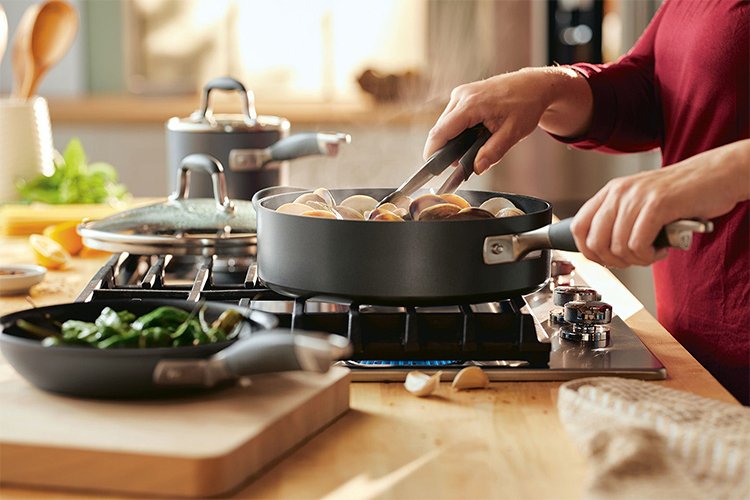
Most Advanced collection pans are oven safe to 400°F. Anolon X goes to 500°F, which is useful if you’re finishing proteins in a hot oven or doing the higher-heat cooking the hybrid surface is built for. Worth checking oven safety specs on individual pieces before you buy if this matters to your cooking.
Induction compatibility varies by line. Some Anolon collections have a stainless steel exterior base that works on induction. Others don’t. If you cook on induction, verify before purchasing — this comes up enough in reviews that it’s clearly a point of confusion.
The things nobody mentions until after purchase
Nonstick coating eventually wears out on every pan. Anolon is honest about this — they don’t market these pans as permanent purchases. With reasonable care the coating lasts longer than most comparably priced alternatives, but it doesn’t last forever.
What constitutes reasonable care in practice: medium heat most of the time, silicone or wooden utensils, handwashing. The dishwasher isn’t going to immediately ruin an Anolon pan but it does accelerate wear. The hard-anodized exterior handles it better than standard aluminum, but the nonstick coating on the interior is still sensitive to harsh detergents used repeatedly.
The Anolon X hybrid surface is more forgiving of metal utensils than standard nonstick — the stainless mesh in the center of the pan handles metal contact without damage. The coated areas around it are still better treated gently.
Weight is on the heavier side for nonstick cookware. The hard-anodized construction is denser than regular aluminum, and some of the larger pieces feel substantial. Not cast iron heavy, but not the weightless experience of cheap nonstick pans either.
Where the price lands
Anolon occupies genuinely good territory on the price-to-quality curve. Better than budget nonstick by enough that the difference is noticeable in daily use. Less expensive than premium brands that charge for brand recognition as much as construction quality.
A mid-size Anolon Advanced skillet runs somewhere around $40 to $60 depending on where you buy and what’s on sale. The Anolon X pieces run higher. Accolade higher still. None of these are impulse purchases but none require the same consideration as dropping $200 on a single HexClad pan.
For buyers who want nonstick cookware that works reliably, lasts, and doesn’t carry a premium for a name that shows up in Instagram ads — Anolon is one of the better answers available.
The actual reason to buy it
There’s a certain kind of cook who appreciates that Anolon doesn’t need a story. They want pans that work. They want them to last. They don’t need the thing sitting on their stove to have a celebrity’s name on it or a color that matches their kitchen aesthetic.
For that cook, Anolon has been quietly delivering for nearly forty years. The culinary schools using it figured this out a long time ago. The rest of the market is gradually catching up.