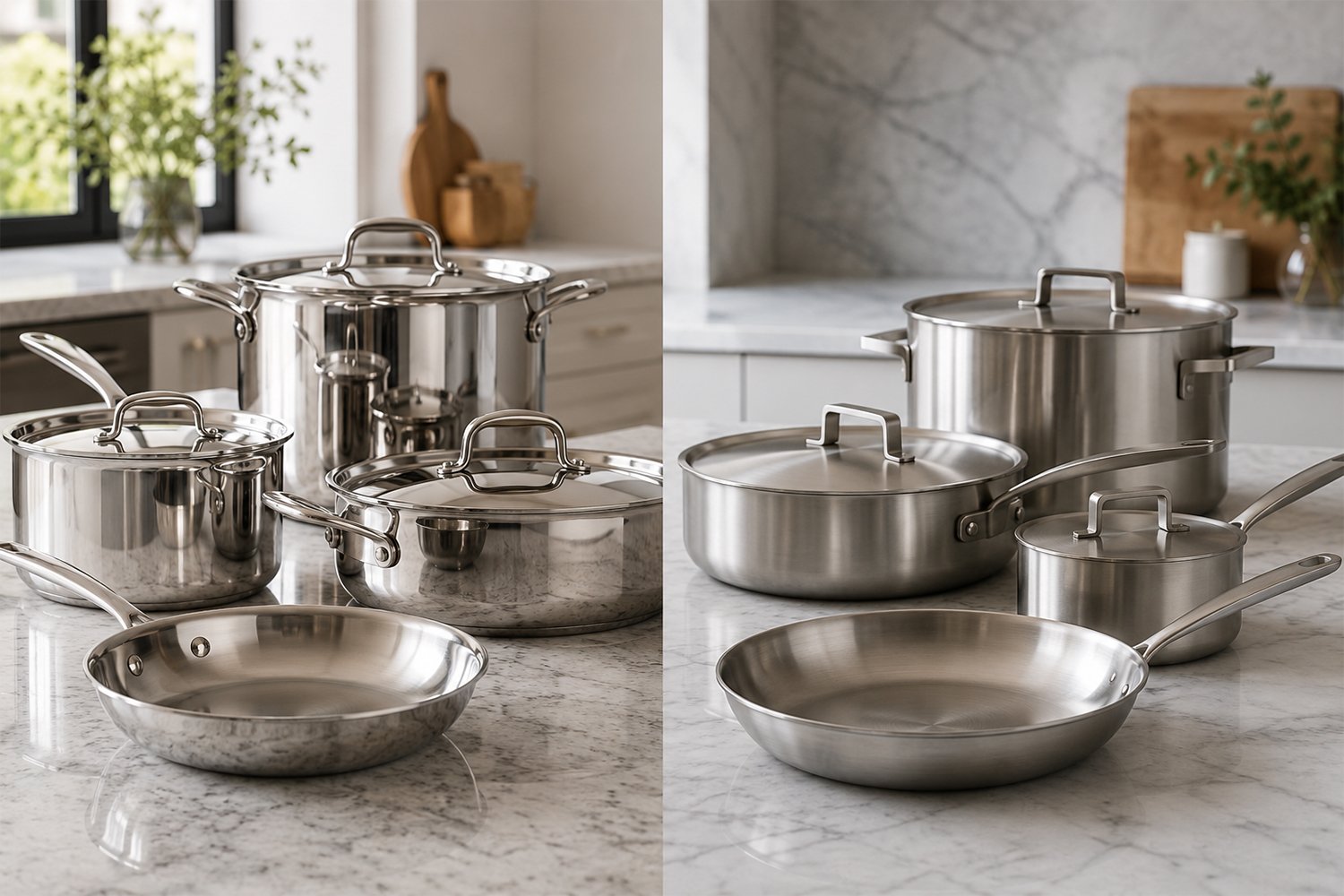

Spending $500 on cookware requires a certain amount of conviction. You’re not testing the waters — you’re committing. And when you’re spending that kind of money, the difference between buying the right thing and buying the wrong thing matters in a way it doesn’t at lower price points.
All-Clad and Made In are the two brands that come up most often when serious home cooks start having this conversation. Both make genuinely excellent stainless steel cookware. Both charge premium prices. And both have devoted fans who will tell you the other brand isn’t worth considering.
Neither camp is entirely right.
What you're actually comparing
All-Clad has been making bonded stainless cookware in Canonsburg, Pennsylvania since 1971. The technology — alternating layers of stainless steel and aluminum bonded together — was developed by a metallurgist named John Ulam who figured out how to get the heat distribution benefits of aluminum with the non-reactive cooking surface of stainless. The D3 collection is three layers. The D5 is five. Copper Core puts a layer of copper in the middle. All of it still made in Pennsylvania.
Made In launched in 2017 with a direct-to-consumer model built around a specific insight: the factories making professional-grade cookware in Europe were producing better product than most home cooks could access at reasonable prices. By cutting out distributors and retailers, Made In could sell five-ply stainless steel — the same construction used in serious restaurant kitchens — at prices significantly below what comparable quality costs through traditional retail. Manufacturing in Italy and France.
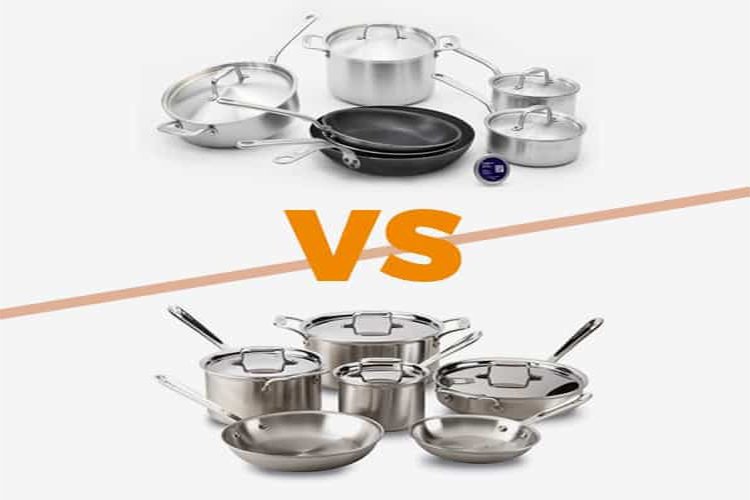
Construction compared
All-Clad D3: three layers, 2.6mm total thickness, fully clad meaning the layers run all the way up the sides of the pan not just the base. The full cladding matters — it means heat distributes up the walls as well as across the bottom, which affects how things cook.
All-Clad D5: five layers, slightly thicker, same full cladding. The extra aluminum layers slow down heat response a little and increase even distribution further. Personal preference determines which you like more.
Made In five-ply: five layers, fully clad, 2.5mm total thickness. Functionally comparable to All-Clad D5 in terms of construction. The materials and layer count are genuinely similar.
The honest comparison between All-Clad D5 and Made In five-ply is that you are getting similar construction at meaningfully different prices. Made In is less expensive. That gap exists because All-Clad sells through retail stores that add their own margin, while Made In sells directly.
Cooking performance
In the kitchen, both perform at a high level. Heat distribution is even. The stainless cooking surface develops proper fond when you’re searing. Both handle the stovetop-to-oven transition cleanly. Both are induction compatible.
The differences are subtle and mostly about feel rather than fundamental performance.
All-Clad’s D3 is lighter and more responsive to heat changes. Turn the heat down and it responds quickly. This is good for delicate sauces and anything requiring fine control. The D5 is slightly heavier and more thermally stable — once it’s at temperature it holds there steadily.
Made In’s five-ply sits in similar territory to the D5 in terms of thermal mass and responsiveness. The cooking experience is comparable.
Where All-Clad has a genuine edge is in handle design for some cooks. The long stick handles keep your hand further from the heat source. Some people find them the most comfortable handles they’ve ever used. Others don’t — the length makes the pans slightly awkward to store and maneuver in a small kitchen. Made In’s handles are shorter and more conventional. Neither is objectively better.
Durability and the warranty question
Both brands make cookware that should last for decades with normal use. Stainless steel bonded cookware doesn’t wear out the way nonstick does. There’s no coating to degrade, no surface to baby.
All-Clad’s lifetime warranty is real and well-established. They’ve been honoring it for fifty years. If something goes wrong with an All-Clad pan under normal use, they deal with it.
Made In has a similar lifetime warranty policy. They’re a newer company so the track record is shorter, but the policy is there.
The price reality
This is where the conversation gets concrete.
An All-Clad D3 10-inch skillet runs around $100 to $130 retail. The D5 version of the same pan is $140 to $160. A D3 ten-piece set is typically $500 to $700 depending on where you buy.
Made In’s ten-inch five-ply skillet is around $109. A comparable set comes in lower than All-Clad’s equivalent.
The gap varies with sales — both brands discount regularly — but Made In is consistently less expensive for comparable construction. That’s not an accident. It’s the whole point of their business model.
When All-Clad is worth the premium
Brand history matters to some buyers in a genuine way. All-Clad has fifty years of consistent manufacturing in one location. The pans your grandmother might have used and the pans you buy today are made the same way in the same place. There’s something real about that continuity.
The retail availability also matters to some buyers. You can walk into a Williams Sonoma or a department store and handle an All-Clad pan before buying it. You can’t do that with Made In. For people who want to feel a pan’s weight and balance before committing, that option has value.
The Copper Core collection is All-Clad’s answer to buyers who want the absolute best heat response available in a stainless pan. Made In doesn’t have a direct equivalent. If copper core performance is what you’re after, All-Clad is where you go.
When Made In is the smarter choice
If you’re making a rational decision about cooking performance per dollar — and you don’t have a specific reason to pay the All-Clad premium — Made In is hard to argue against. The five-ply construction is real, the manufacturing quality is real, and the price reflects the direct sales model rather than a retail markup stack.
For equipping a full kitchen from scratch, the savings add up to something meaningful. That money could go toward a better knife, a Dutch oven, or simply staying in your budget.
The actual answer
Both brands make cookware that will last a very long time and perform consistently. You won’t regret buying either one.
If you’re buying one or two pieces and want the best possible version of each regardless of price — All-Clad, probably the D3 or Copper Core depending on what you’re cooking.
If you’re equipping a kitchen more completely and care about value as much as quality — Made In delivers comparable performance for less money and the difference is real.