There’s a version of cookware loyalty that doesn’t make complete rational sense. People hold onto their All-Clad pans the way other people hold onto old leather jackets or cars that have long since been paid off. They’re not cheap. They require some care. There are newer brands with more interesting stories and better Instagram presence.
And yet. The All-Clad pans stay.
A metallurgist in Pennsylvania starts something
John Ulam was a metallurgist working in Canonsburg, Pennsylvania — a town with a long history in the metals industry — when he figured out how to bond different metals together in a way that hadn’t been done before for cookware.
The year was 1971. The insight was that aluminum conducts heat beautifully but reacts with acidic food, while stainless steel is inert and durable but distributes heat poorly. Bond them together properly — stainless on the cooking surface, aluminum running through the core, stainless on the exterior — and you get both. Even heat distribution from the aluminum, non-reactive cooking surface and durable exterior from the stainless.
This sounds straightforward now because the concept has been copied so many times. In 1971 it was genuinely new. The technology Ulam developed, called bonded construction, is what All-Clad still uses today and what the entire category of serious stainless cookware is built around.
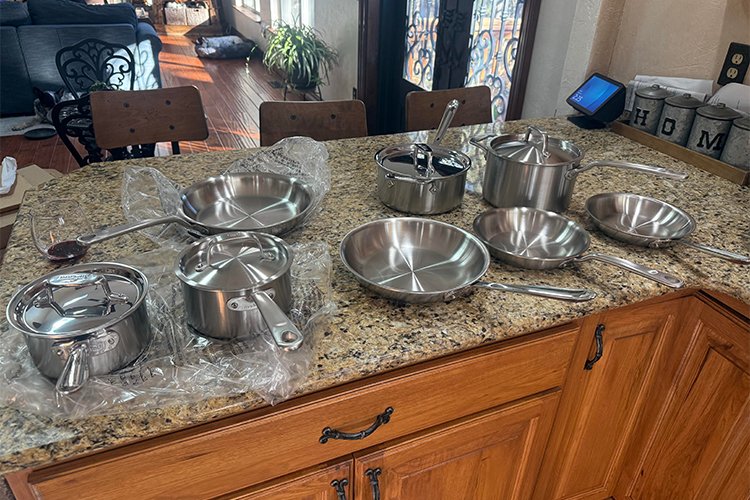
The company has been owned by different parent companies over the decades — currently by SEB Group, the French conglomerate that also owns Lagostina, T-fal, and Rowenta. But the manufacturing has stayed in Canonsburg. That’s not a small thing. All-Clad pans are still made in Pennsylvania, by workers who have often been there for decades, on equipment that has been refined over fifty years.
The product lines
All-Clad’s lineup can feel complicated if you’re coming to it fresh. There are multiple collections — D3, D5, Copper Core, G5, HA1, and a few others — and the differences between them aren’t always obvious from the names.
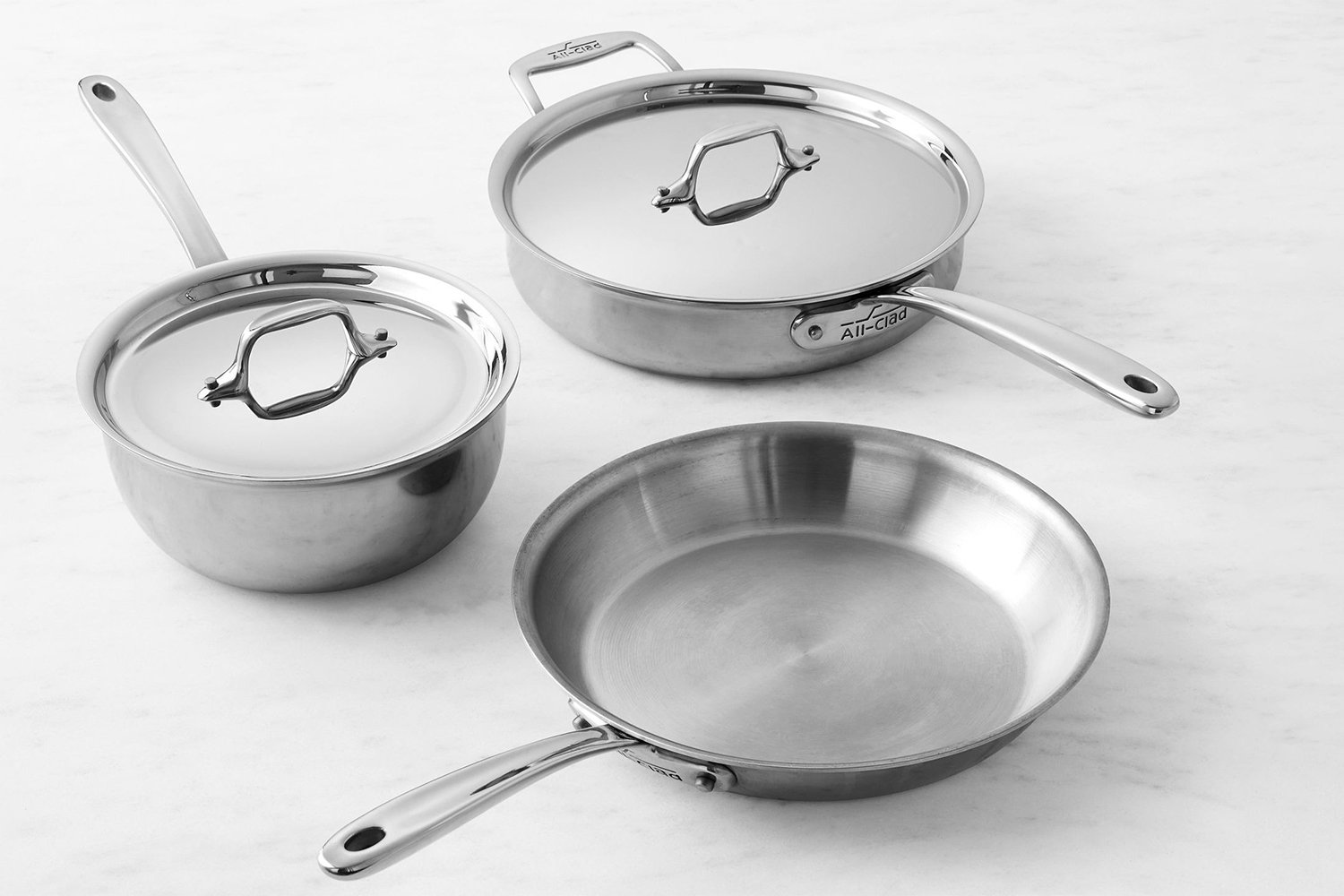
The D3 is three layers: stainless, aluminum, stainless. It’s the original, it’s the most affordable entry point into the All-Clad world, and it’s the one most professional cooks reach for first. Responsive to heat changes, lightweight enough to handle comfortably, performs beautifully. For most home cooks this is the right choice.
The D5 adds two more layers — five total, alternating stainless and aluminum. The extra layers slow down the heat response slightly, which actually helps with even distribution and reduces the risk of hot spots. Some cooks prefer this for things like sauces where steady, controlled heat matters. Others find the D3 more responsive and prefer that.
Copper Core is what it sounds like. A layer of copper runs through the center of the five-ply construction. Copper conducts heat even better than aluminum and responds to temperature changes faster than any other common cookware metal. These are All-Clad’s highest-performing pans and also their most expensive. For people who cook seriously and want the absolute best heat control available in a stainless pan, Copper Core delivers it.
The nonstick lines — HA1 and others — use PTFE coatings on an aluminum base. These are good nonstick pans but not All-Clad’s strength. The brand’s real identity is bonded stainless.
Why this cookware has lasted fifty years
The obvious answer is that it performs consistently. An All-Clad D3 skillet bought today performs the same as one bought fifteen years ago — because nothing meaningful has changed in how it’s made. That kind of consistency is actually rare. A lot of brands optimize for the sale rather than for what happens after the sale.
There’s also the warranty. All-Clad offers a lifetime warranty on their bonded cookware. Not a marketing lifetime. An actual one — they will repair or replace a pan that fails under normal use. This matters when you’re considering the real cost of cookware over time. A $200 pan you replace once every two years is more expensive than a $160 pan you use for fifteen.
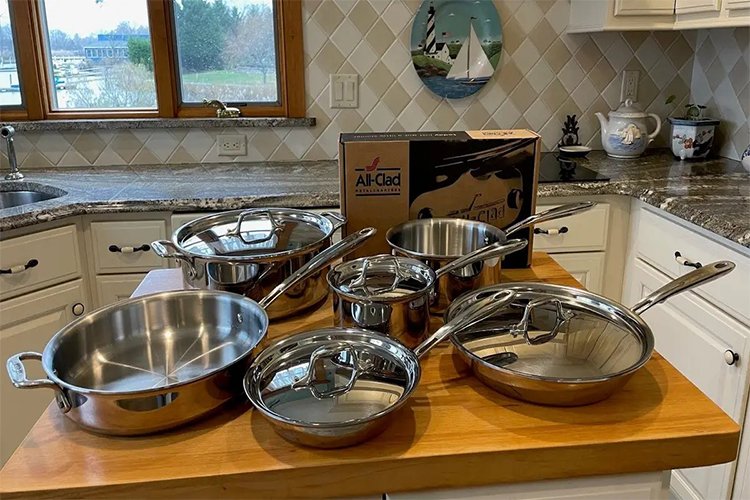
The handles are worth mentioning. All-Clad’s stick handles are a polarizing design — long, slightly angled, riveted securely to the body of the pan. Some people find them the most comfortable handles they’ve ever used. Some find them awkward. The length is intentional — it keeps your hand further from the heat source. But it also means All-Clad pans don’t fit in every cabinet or on every pot rack the way shorter-handled alternatives do.
The sticking point
Stainless steel sticks. That’s not a flaw in All-Clad specifically — it’s just how stainless works if you don’t use it correctly.
The technique is simple once you know it. Preheat the pan over medium heat until a drop of water beads up and moves around rather than evaporating on contact. Add your oil or fat, let it heat for a few seconds, then add your food. Protein will initially want to stick and then release naturally when it’s ready — this is the Maillard reaction doing its job. Don’t force it, don’t panic, just wait.
Once this becomes muscle memory it’s not a big deal at all. Until it does, there’s a learning curve that surprises people who are used to nonstick.
The price conversation
All-Clad is expensive. A D3 skillet runs around $100 to $130. The full D3 ten-piece set is several hundred dollars. Copper Core adds another significant premium on top of that.
For people who cook regularly and plan to keep their cookware for a long time, the math works out. Spread over fifteen years of daily use, a $130 skillet that performs consistently and comes with a lifetime warranty is a different purchase than it looks like on the price tag.
For people who cook occasionally or aren’t sure how long they’ll hold onto a pan, the price is harder to justify. There are good stainless options at lower price points — Made In being the obvious current example.
But there’s a reason All-Clad is still sitting in professional kitchens and serious home cooks’ cabinets fifty years after a metallurgist in Pennsylvania figured out how to bond metals together. It works. That’s really the whole story.