Most cookware doesn’t get handed down through families. Most cookware ends up in a landfill within a decade, replaced by something newer or cheaper or just different. Le Creuset is the exception to this in a way that no other cookware brand really is.
People inherit Le Creuset Dutch ovens from their grandmothers. They specify colors in their wedding registries like they’re choosing furniture. They display the pots on their stoves even when they’re not cooking anything, because the pots look that good. This is strange behavior for a piece of kitchen equipment. It’s worth understanding why it happens.
A foundry in northern France, 1925
Le Creuset was founded in Fresnoy-le-Grand, in the Aisne region of France, in 1925. Two Belgian industrialists — Armand Desaegher and Octave Aubecq — combined their skills: one knew cast iron casting, one knew enameling. The combination produced something the cookware world hadn’t quite seen before: cast iron cookware with a vitreous enamel coating.
The enamel solved several practical problems with raw cast iron. It eliminated the need for seasoning. It made the surface non-reactive, so you could cook acidic dishes like tomato sauce or wine-based braises without any metallic flavor transferring to the food. It made cleanup significantly easier. And it came in colors — starting with the now-iconic Flame orange that is still in production today.
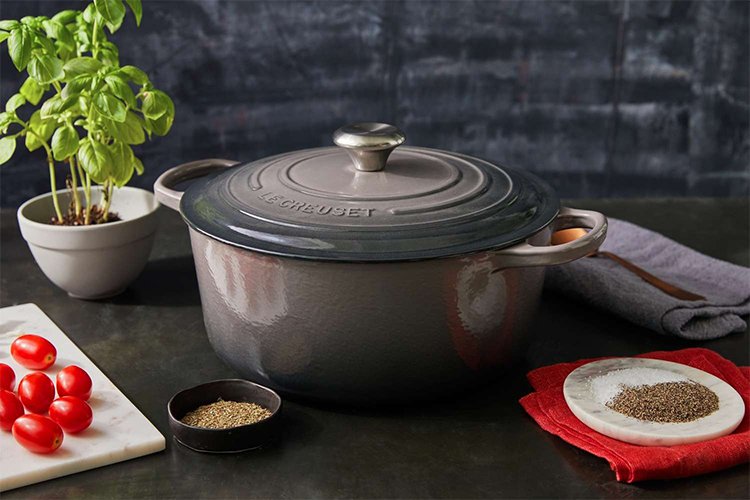
The company has been in the same part of France since the beginning. Each Le Creuset piece is still cast individually in sand molds — a process that hasn’t fundamentally changed in a hundred years. The enamel is applied by hand in multiple coats and fired at temperatures around 800 degrees Celsius. Some pieces go through this process more than once to achieve the right finish.
What Le Creuset actually makes
The Dutch oven is the product that built the brand’s American reputation, and it’s still the thing people picture when they hear the name. Round or oval, in sizes ranging from a tiny 1-quart up to a massive 13-quart, and available in more colors than most paint stores carry. The full-size round Dutch oven is the workhorse — suitable for braising, soups, stews, bread baking, and essentially any slow cooking application you can think of.
Beyond the Dutch oven, Le Creuset makes skillets, braisers, saucepans, tagines, and a full line of stoneware for baking and serving. They also make enameled steel cookware under the same name, which is lighter and more affordable than the cast iron but not the same product.
The cast iron skillets deserve more attention than they get. Because the Dutch oven is so dominant in the brand’s reputation, the skillets are sometimes overlooked. They shouldn’t be. A Le Creuset cast iron skillet develops excellent heat retention, handles high oven temperatures, and with reasonable care will be performing identically in thirty years.
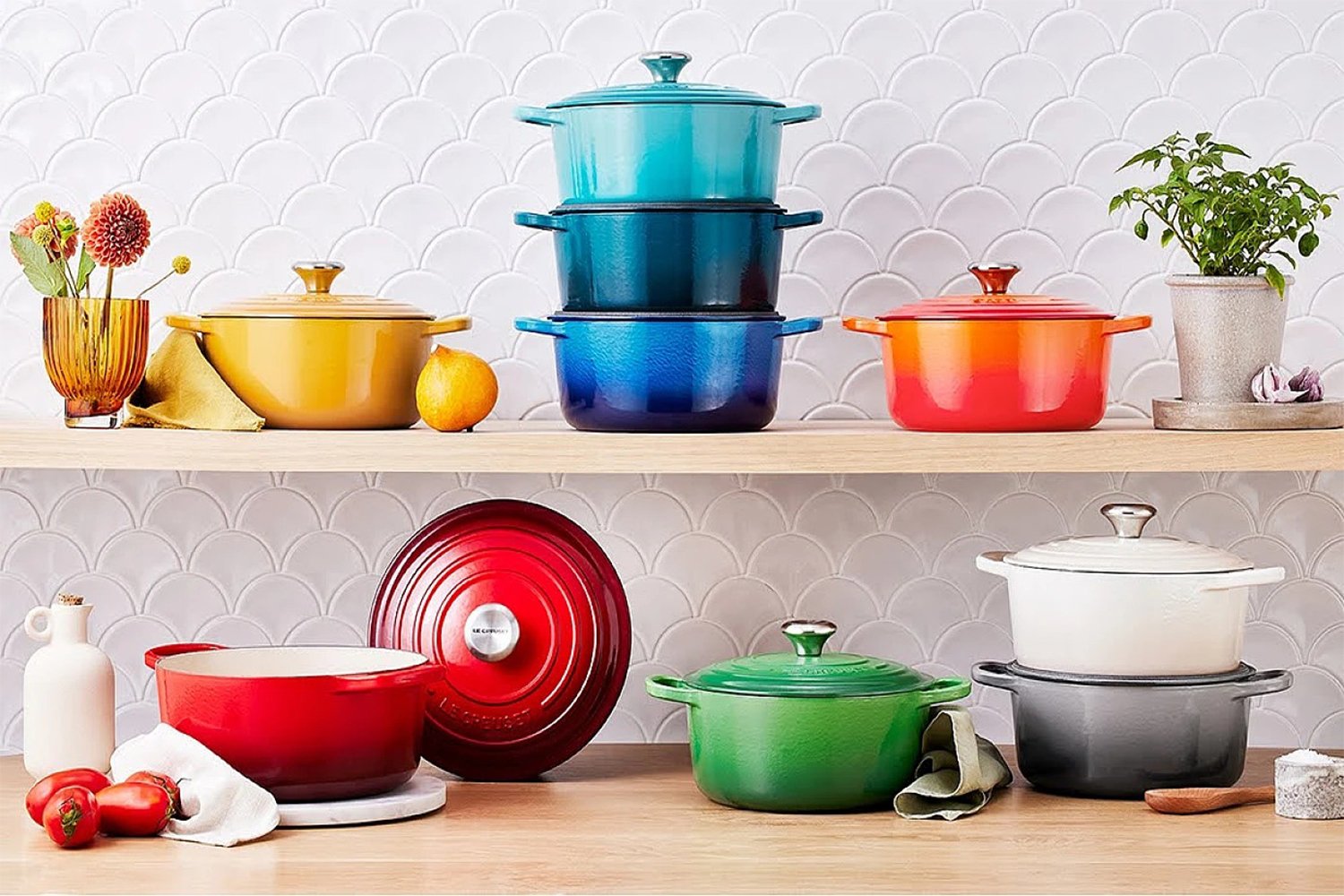
The color range is genuinely remarkable in scope. Classic Flame, Marseille blue, Cerise red, Sage, Deep Teal, Shallot, and seasonal colors that rotate in and out of the range throughout the year. Limited editions sell out quickly. Some colors that have been discontinued trade on secondary markets at prices that would make you think they were collectible art rather than cooking vessels.
In some ways, that’s exactly what they are.
The heat retention thing is real
Cast iron holds heat differently than any other cookware material. Once it’s up to temperature it stays there, distributing that stored energy evenly across the entire cooking surface and up the walls of the vessel.
This makes Le Creuset’s Dutch ovens genuinely excellent for anything that benefits from steady, maintained heat — braised short ribs, slow-cooked beans, no-knead bread. The oven can cycle on and off as it regulates temperature and the pot barely registers it. The food inside cooks in stable conditions.
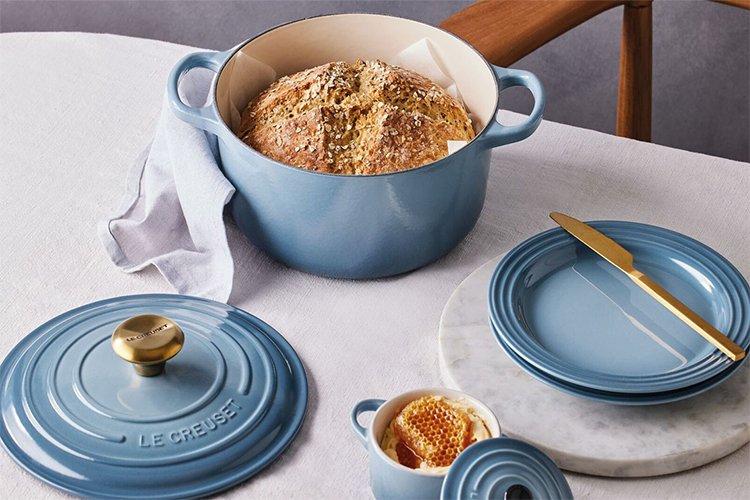
It’s not the right tool for every job. Cast iron is slow to heat up and slow to cool down. It’s not responsive in the way that stainless or carbon steel is. If you want to make a quick pan sauce that requires fine control over heat, something else will serve you better. But for slow cooking, for bread, for anything where you want the pan to maintain heat rather than respond to it — Le Creuset cast iron is in a different category from almost everything else.
Why it costs what it costs
A standard Le Creuset round Dutch oven in a mid-size runs somewhere between $350 and $420 retail. That’s a significant amount of money for a cooking vessel.
The cost is real manufacturing cost, not just brand premium. Individual casting in sand molds means each piece is a physical object that required human hands at multiple stages of production. The enamel application and firing process is labor-intensive. Quality control on a product that’s expected to last a lifetime requires rejecting pieces that don’t meet standard — those don’t get sold, they add to production cost.
You’re also paying for a warranty that covers the lifetime of the original owner. Not a limited warranty. The actual lifetime of the person who bought it.
Whether that price is justified depends on how you cook and how you think about purchases. If you braise regularly, bake bread, make long slow soups — you will use a Le Creuset Dutch oven constantly and it will never give you a reason to replace it. Amortized over twenty or thirty years of use, it becomes a reasonable purchase.
If you rarely cook things that require a Dutch oven, you’ll have a very beautiful and very expensive storage problem on your hands.
The part people don't mention enough
Le Creuset is heavy. A full-size Dutch oven with a lid, loaded with a braise, weighs enough that it’s worth thinking about before you buy. People with wrist or shoulder issues sometimes find Le Creuset cast iron difficult to manage safely. This is worth considering honestly before you commit to the purchase, because the weight is not going to change.
The enamel can chip if you drop the piece on a hard surface or bang the rim sharply against something. It won’t chip from normal use — cooking, stirring with wooden spoons, washing — but it’s not indestructible. Small chips on the rim don’t affect performance. Chips on the cooking surface are more of an issue.
These are not reasons not to buy Le Creuset. They’re just things that are useful to know before you do.
What the cult following is actually about
People are not irrational for caring about Le Creuset the way they do. There’s a cooking experience that these pieces provide — the weight of the lid sealing in moisture, the way a long braise smells coming out of that enameled interior, the pot sitting on the stove afterward still warm an hour later — that cheaper alternatives don’t replicate.
Some things in a kitchen are tools. Le Creuset is something more than that for the people who cook with it regularly. That’s a hard thing to explain until you’ve experienced it, and then it requires no explanation at all.