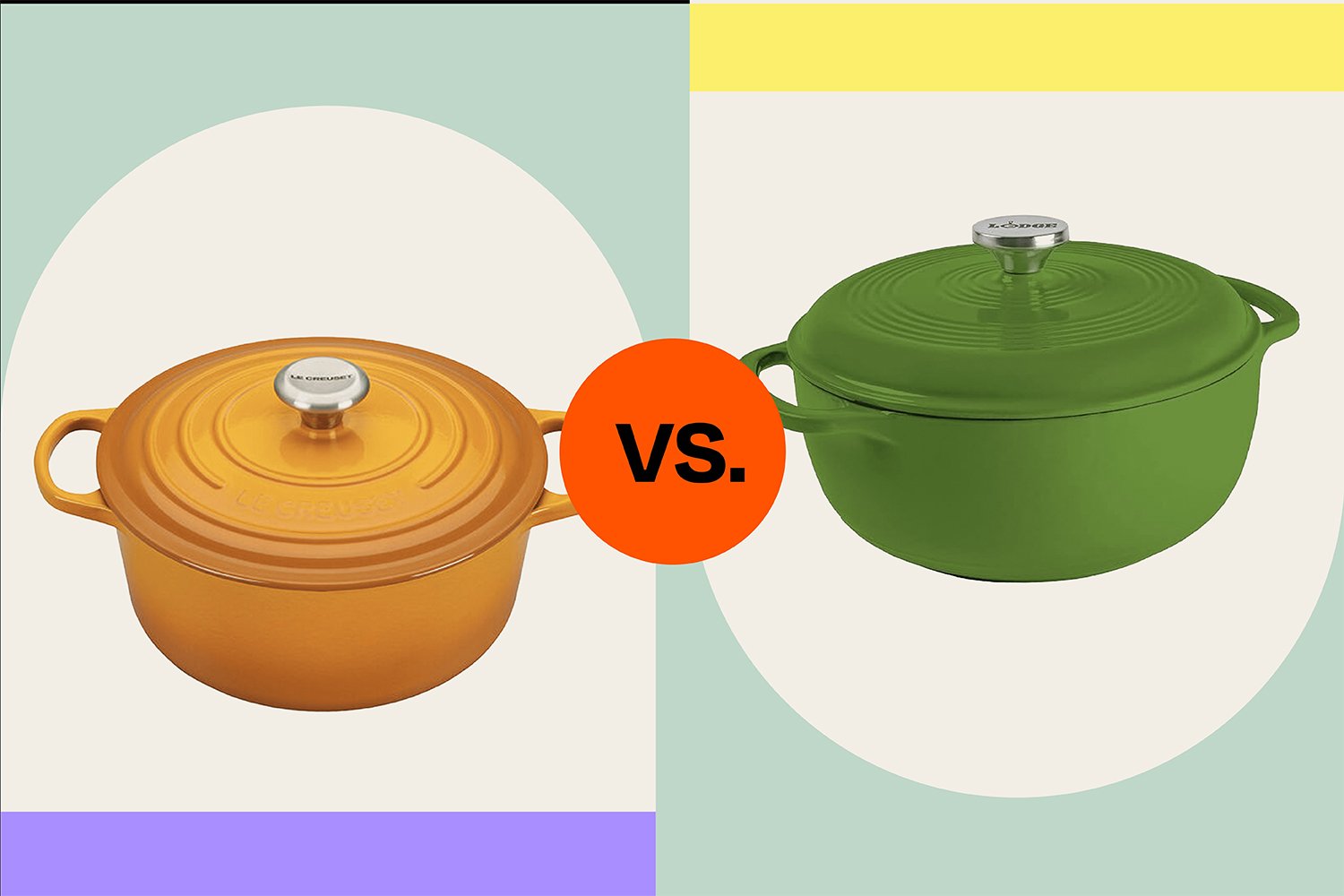

The price difference between a Lodge cast iron skillet and a comparable Le Creuset is somewhere in the range of ten to one. That’s a gap that demands an explanation — and the explanation is more interesting than either brand’s marketing fully acknowledges.
Two very different products
This comparison is sometimes framed as Lodge being the smart budget choice and Le Creuset being an overpriced luxury item. That framing misses something. These aren’t the same product at different price points. They’re different products that share a material.
Lodge makes raw cast iron — unseasoned or pre-seasoned, no enamel coating, iron all the way through. Le Creuset makes enameled cast iron — the iron is coated inside and out with a vitreous enamel that changes how the pan behaves significantly.
Once you understand that distinction, the price comparison becomes more logical and less mysterious.
Raw cast iron — what Lodge actually is
Lodge has been making cast iron in South Pittsburg, Tennessee since 1896. They make one thing — cast iron — and they’ve made it in the same location for over a century. The raw cast iron skillet you buy from Lodge today is made using the same fundamental process as the ones made in 1950.
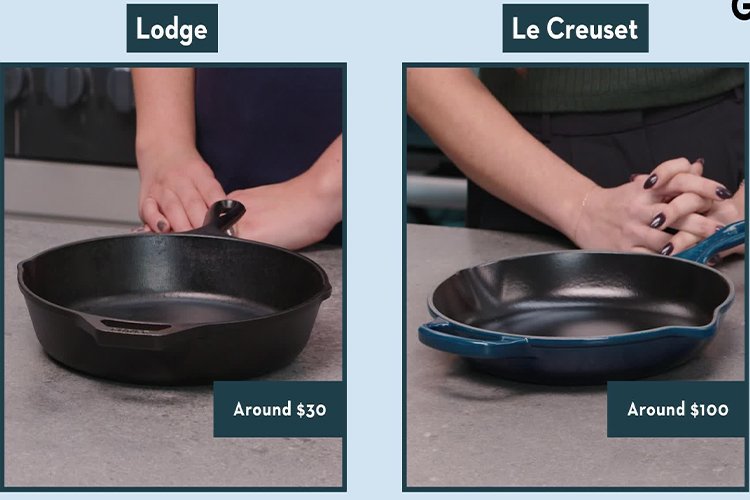
Raw cast iron needs seasoning — a layer of polymerized oil that builds up on the surface and creates a natural nonstick coating. Lodge pre-seasons their pans at the factory now, which helps, but the real seasoning develops over time through cooking. The first few months with a Lodge skillet are a process of building up that seasoning layer. After that, a well-seasoned Lodge skillet has a cooking surface that improves the more you use it.
Raw cast iron is reactive with acidic food when new and under-seasoned. Long tomato-based braises in a poorly seasoned Lodge skillet can pick up metallic flavor and strip the seasoning. Once properly seasoned this is less of an issue, but it’s something to know.
Maintenance involves drying thoroughly after washing — rust forms quickly on unseasoned or wet cast iron — and occasional re-seasoning if the surface starts to look dull or food begins to stick.
The price for all of this: around $25 to $35 for a 10-inch skillet.
Enameled cast iron — what Le Creuset actually is
The enamel coating changes the fundamental nature of the cookware. The interior cooking surface is non-reactive — you can cook tomato sauce, wine braises, and acidic dishes without any concern about metallic flavor or surface damage. Cleanup is significantly easier than raw cast iron. No seasoning required, ever.
The enamel also means Le Creuset cast iron cannot rust. You can wash it thoroughly with soap, leave it wet briefly, and nothing bad happens. The maintenance burden is dramatically lower than raw cast iron.
The cooking properties of the cast iron base — excellent heat retention, slow and even distribution, performance in the oven at very high temperatures — are preserved under the enamel. You get cast iron’s thermal benefits without cast iron’s maintenance requirements.
What you give up compared to raw cast iron: the naturally developed nonstick surface that comes from years of seasoning. Le Creuset’s enamel provides some nonstick properties but not the deep, well-seasoned surface of a properly maintained Lodge that has been used for a decade.
The price: $150 to $250 for a comparable skillet, $350 to $420 for a Dutch oven.
Where Lodge outperforms
A well-seasoned Lodge skillet develops cooking properties that enameled cast iron can’t match. The seasoned surface browns food with a particular quality — a deep, even crust on cornbread, a sear on steak that transfers directly without any coating between the meat and the iron. Cast iron purists will tell you nothing compares to this and they’re not wrong.
Lodge is also indestructible in a way that enameled cast iron isn’t. Drop a Lodge skillet and you might chip the floor. The pan is fine. Drop a Le Creuset and there’s a meaningful chance the enamel chips. Small chips on the rim are cosmetic. Chips on the cooking surface are more serious.
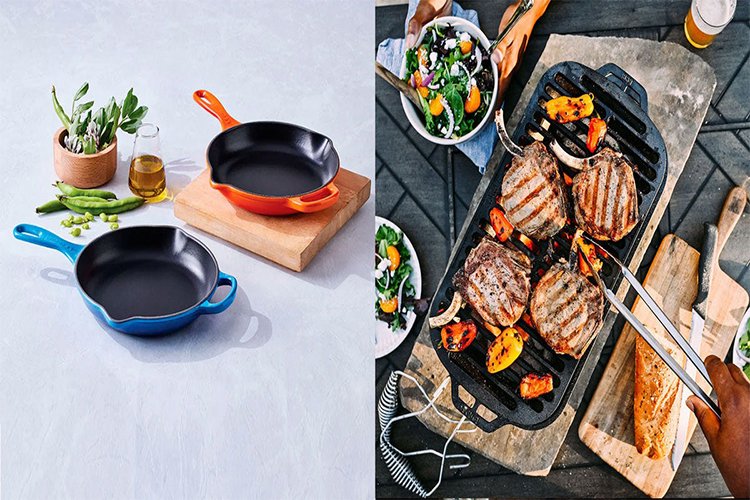
For outdoor cooking, camping, cooking over open fire — Lodge is the obvious choice. Enamel doesn’t love open flame and temperature extremes the way raw iron does.
Where Le Creuset outperforms
Anything that benefits from non-reactive cooking surface — braised dishes with wine, tomatoes, citrus. The enamel makes these completely straightforward in a way that requires more care with raw cast iron.
The Dutch oven form factor is where Le Creuset’s reputation was built, and for good reason. The combination of cast iron heat retention, non-reactive enamel interior, and tight-fitting lid creates an environment for braising that’s genuinely difficult to replicate. A Le Creuset Dutch oven loaded with short ribs or a whole chicken and put in a low oven for three hours produces results that are hard to argue with.
Maintenance being lower matters to a lot of people. Not everyone wants to think about seasoning and rust prevention. Le Creuset removes that consideration entirely.
The actual decision
Buy Lodge if you want the cast iron cooking experience in its purest form, you’re willing to invest the time in seasoning and maintenance, and you don’t want to spend $300 on a pan. The Lodge 12-inch skillet at $35 is one of the best value purchases in cookware.
Buy Le Creuset if you want enameled cast iron’s specific advantages — non-reactive surface, lower maintenance, the Dutch oven form factor for braising — and you’re comfortable with the price. The lifetime warranty means you’re buying once.
Buying both isn’t unreasonable. A Lodge skillet for searing and stovetop work, a Le Creuset Dutch oven for braises and slow cooking. These are genuinely different tools that complement rather than replace each other.