Here’s the problem with buying nonstick cookware. Every single brand uses the same words. Scratch-resistant. Long-lasting. Professional grade. PFAS-free. You read ten product pages and come away knowing nothing more than when you started, except that everyone apparently makes the best pan ever made.
So let’s skip all of that and talk about what actually separates a nonstick set worth buying from one that ends up in a donation pile eighteen months later.
The thing nobody explains clearly enough
There are two fundamentally different types of nonstick coating on the market and they behave differently in ways that matter.
PTFE — which most people know as Teflon, though that’s just one brand name — is a fluoropolymer that has been used in nonstick cookware for decades. When it’s applied properly in multiple layers over a good base, it’s the most durable nonstick surface available. Food releases cleanly, it holds up to regular use, and a well-made PTFE pan will still be performing after several years of daily cooking. The concern people have with PTFE is about a manufacturing chemical called PFOA that was used in its production — but PFOA was phased out of US manufacturing by 2013. Current PTFE cookware from reputable brands is PFOA-free.
Ceramic nonstick is the newer category. No PTFE, no PFAS chemicals at all — the coating is derived from silicon dioxide, essentially a form of glass. It’s genuinely cleaner from a chemical standpoint and performs beautifully when new. The trade-off is longevity. Ceramic coatings degrade faster than PTFE under the same conditions. With careful use — low to medium heat, soft utensils, handwashing — a good ceramic pan lasts two to three years. Push it harder and it fades sooner.
Neither is the wrong choice. They suit different priorities. Knowing which one you’re buying matters.
What actually makes a nonstick set worth the money
The base material under the coating is more important than most buyers realize. Hard-anodized aluminum is meaningfully better than standard aluminum — it’s harder, more thermally stable, and provides a more uniform surface for the coating to bond to. Pans built on hard-anodized bases last longer, full stop.
Set composition matters too. A five-piece set with pieces you’ll actually use every day beats a twelve-piece set that pads the count with redundant sizes and lids counted as separate items. Most people genuinely need a large skillet, a medium sauté pan, and a sauce pan. Everything else is nice to have but not essential.
The sets worth buying
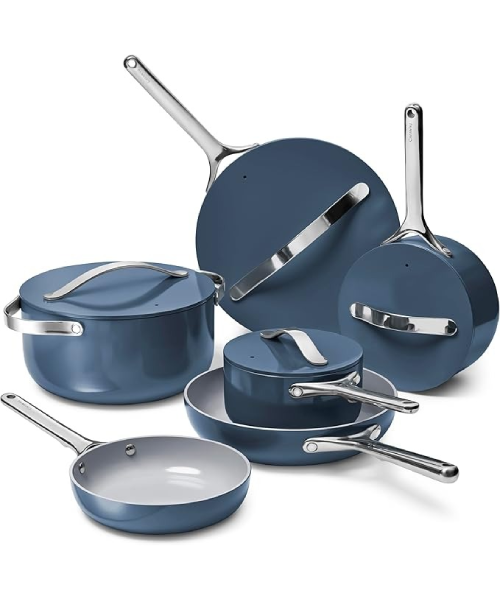
Coating: Ceramic — PTFE-free, PFAS-free Base: Aluminum core Pieces: 4 — fry pan, sauté pan, sauce pan, Dutch oven Oven safe: 550°F Price range: Around $395 for the full set
Caraway is the brand that made ceramic nonstick genuinely desirable rather than just an alternative to PTFE. The four-piece set is well-composed — nothing redundant, everything useful. The fry pan handles eggs and fish. The sauté pan is the workhorse for sauces and everyday cooking. The Dutch oven pulls double duty on stovetop and in the oven.
The storage system that comes with the set — a magnetic pan rack and canvas lid holder — is one of the better design decisions in consumer cookware. Ceramic surfaces scratch when stacked. Caraway solves that problem and includes the solution in the box.
Performance out of the box is excellent. The coating feels genuinely smooth, food releases cleanly, and cleanup is quick. Where you feel the trade-off is over time — ceramic degrades faster than PTFE and Caraway is no exception. With good care most people get a solid two to three years. Some get more. Some get less depending on how well they follow the low-heat guidance.
Worth buying if design and chemical cleanliness both matter to you and you’re willing to treat the pans properly.
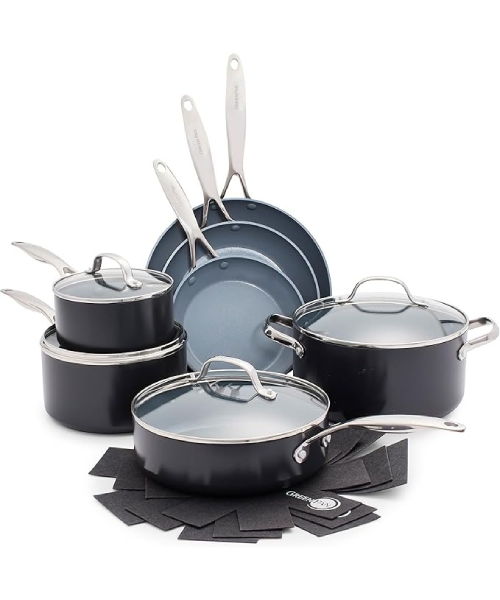
Coating: Thermolon ceramic — PTFE-free, PFAS-free Base: Hard-anodized aluminum Oven safe: 600°F Price range: Less expensive than Caraway for comparable piece count
GreenPan invented mainstream ceramic nonstick in 2007 and has spent fifteen years making the coating better. The Valencia Pro collection reflects that development time — the hard-anodized base provides more stable heat distribution than standard aluminum, and the Thermolon coating in its current form is more durable than earlier versions.
The honest comparison to Caraway: GreenPan Valencia Pro is the better technical product. Hard-anodized construction, longer coating development history, lower price. Caraway is the better lifestyle product — better design, better storage solution, more thoughtful ownership experience overall.
If you care about performance and value more than aesthetics, Valencia Pro is the right call.
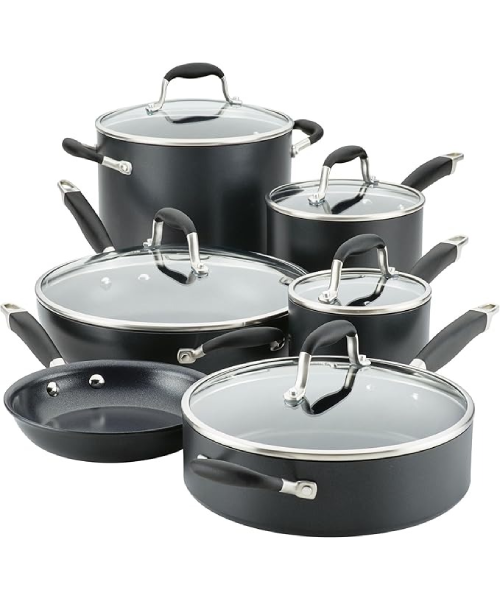
Coating: Multi-layer PTFE — PFOA-free Base: Hard-anodized aluminum Oven safe: 400°F Price range: Mid-range, frequently on sale
Anolon Advanced is the answer for buyers who want nonstick cookware that works reliably for several years without much fuss. The hard-anodized base is the same advantage as GreenPan — more stable, better heat distribution. The PTFE coating applied over it is more durable than ceramic alternatives at the same price.
The handles are genuinely comfortable — double-riveted, silicone grip section, good length. This sounds minor until you’ve cooked with a handle that doesn’t work for forty-five minutes straight.
Anolon Advanced shows up in culinary school kitchens because it holds up under conditions that destroy cheaper pans. That’s about as honest an endorsement as exists in this category.
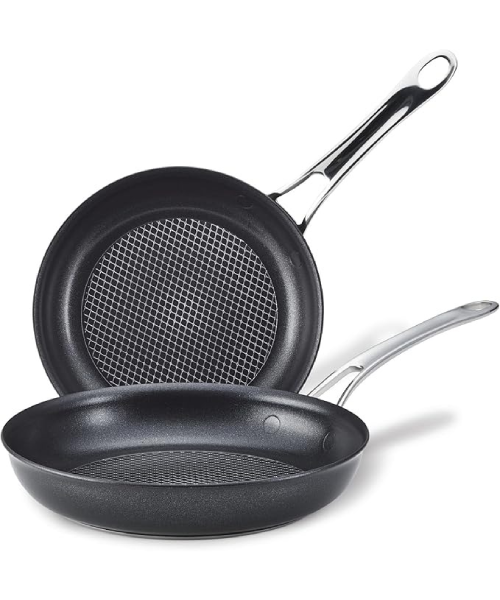
Coating: Hybrid — stainless steel mesh center with PTFE coating surrounding it Base: Hard-anodized aluminum Oven safe: 500°F Price range: Higher than Advanced, lower than HexClad
The stainless steel mesh embedded in the center of the cooking surface is what separates Anolon X from everything else on this list. The mesh gets genuinely hot and creates real browning on meat — actual Maillard reaction, actual crust — while the coated area around it handles everything else with nonstick convenience. It’s a hybrid concept that predates HexClad and works well in a different way.
For cooks who want one pan that handles eggs in the morning and a proper steak sear at night, Anolon X is the most sensible way to get there without spending HexClad money.
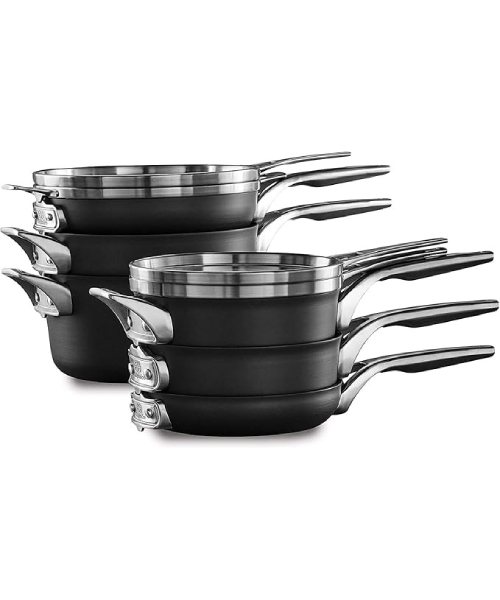
Coating: Three-layer PTFE — PFOA-free Base: Hard-anodized aluminum Oven safe: 500°F Price range: Mid-range, similar to Anolon Advanced
Calphalon and Anolon are owned by the same parent company, which explains why these sets occupy similar territory. Premier’s main advantage over Anolon Advanced is the higher oven tolerance — 500°F versus 400°F — which matters if you regularly finish dishes in a hot oven. The three-layer coating is also slightly more robust than two-layer alternatives.
For stovetop-to-oven cooking specifically, Premier earns its place on this list.
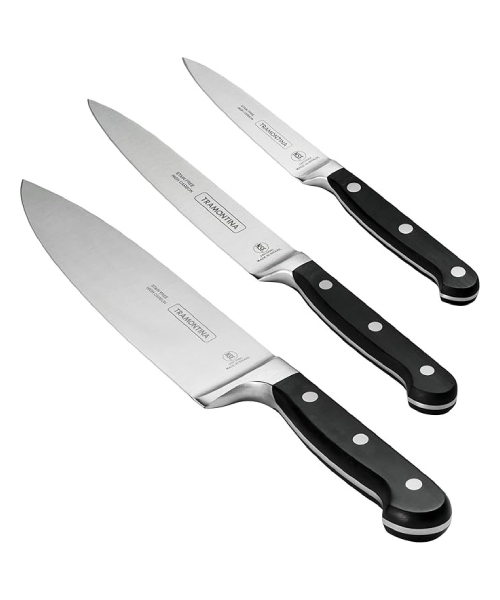
Coating: PTFE — PFOA-free Base: Heavy-gauge aluminum Oven safe: 400°F Price range: Budget — significantly less than the above options
Restaurant supply houses stock Tramontina Professional for commercial kitchens that need reliable nonstick at volume. The pans are heavier than most consumer options, the coating is durable, and the price is genuinely low. The aesthetic is completely utilitarian — these look like diner kitchen equipment because they are diner kitchen equipment.
If you’re setting up a first kitchen and don’t want to spend Caraway or Anolon money yet, Tramontina Professional is the honest budget recommendation. It performs far better than the price suggests.
What to skip entirely
Any set with a piece count above ten that isn’t including obviously useful items. Sets claiming full ceramic coating at $40 for eight pieces. Anything with vague coating descriptions that avoid saying whether it’s PTFE or ceramic.
The cookware market has a lot of products that look like the real thing and aren’t. Stick with brands that are specific about materials, manufacturing, and coating technology.
The short version
Ceramic nonstick that cares about design: Caraway. Ceramic nonstick that cares about performance: GreenPan Valencia Pro. PTFE nonstick for everyday reliability: Anolon Advanced. PTFE nonstick with searing capability: Anolon X. Budget option that actually works: Tramontina Professional.