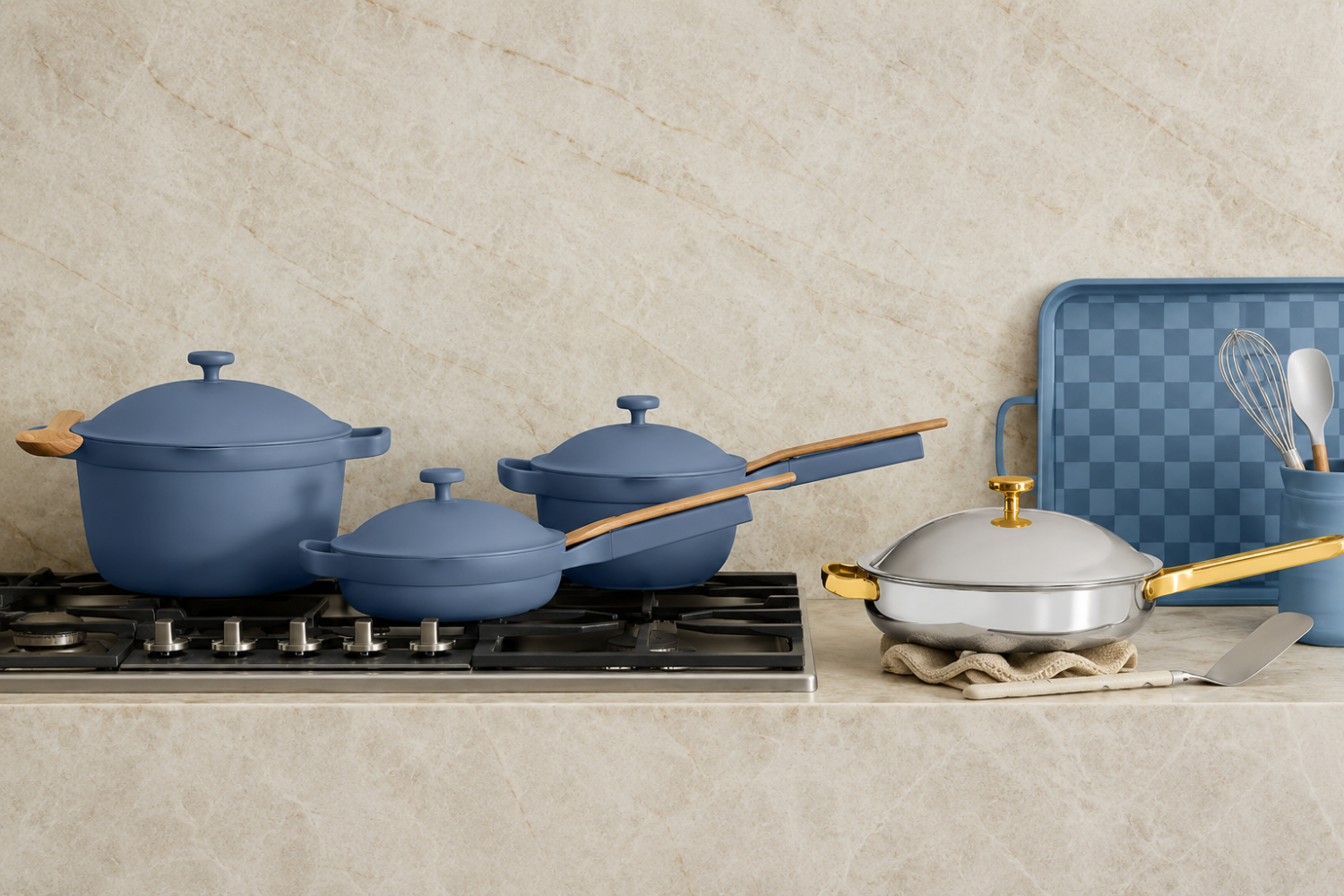
Gas stove cooking and electric or induction cooking are different enough that the cookware choice deserves specific consideration. The open flame of a gas burner creates a different heat pattern than a flat electric element — more concentrated in the center, more variable across the surface — and not all cookware handles that variation equally well.
What gas heat does differently
A gas flame concentrates heat directly under the pan in a circle that corresponds to the burner size. The center of the pan gets hit first and hardest. Materials that distribute heat poorly will have a noticeably hot center and cooler edges, which creates uneven cooking that’s frustrating for anything requiring consistent surface temperature.
This is why fully clad multi-ply stainless steel and hard-anodized aluminum both perform well on gas — the layered construction spreads that concentrated central heat across the cooking surface before it reaches the food.
Thin single-layer materials — cheap aluminum, thin stainless with only a base disk — perform poorly on gas for exactly this reason.
Best cookware materials for gas stoves
Fully clad stainless steel is the strongest performer on gas. The aluminum or copper layers in a properly clad pan take the concentrated flame heat and distribute it evenly. All-Clad D3, Made In five-ply, Demeyere Industry 5 — any of these handle gas heat excellently.
Hard-anodized aluminum distributes heat well and responds quickly to flame changes. Anolon Advanced, GreenPan Valencia Pro — both work very well on gas.
Raw cast iron handles gas well once up to temperature. The slow thermal mass of cast iron smooths out the uneven initial heating from the flame. Lodge skillets on a gas burner, once preheated properly, cook with excellent evenness.
Enameled cast iron — Le Creuset, Staub — performs the same way on gas as raw cast iron. No concerns.
What to avoid on gas
Thin stainless steel with only a base disk — not fully clad. The sides of the pan are single-layer stainless with poor heat distribution, and the disk base creates an abrupt transition between hot base and cool sides.
Very thin aluminum pans. Gas flame is aggressive enough that thin aluminum develops hot spots quickly and can warp over time.
Glass lids and glass cookware generally struggle with the direct heat variation of gas flames.
Specific recommendations for gas stoves
Best overall: All-Clad D3 or Made In five-ply. Fully clad construction handles gas heat better than anything else at the relevant price points.
Best nonstick on gas: GreenPan Valencia Pro. Hard-anodized base distributes gas heat evenly. Use on medium rather than high — gas flames reach high temperatures quickly.
Best cast iron on gas: Lodge 12-inch skillet for everyday cooking, Le Creuset Dutch oven for braising. Both handle gas heat comfortably.
Best budget option on gas: Tramontina Tri-Ply Clad. Genuine triple-ply construction at a price that makes it accessible. Handles gas well.
One practical note
Gas burners vary significantly in output. A high-BTU professional-style range pushes more heat than a standard residential burner. On very high-BTU ranges, even good cookware needs some heat management — start on medium and adjust up rather than immediately using the full output of a powerful burner.