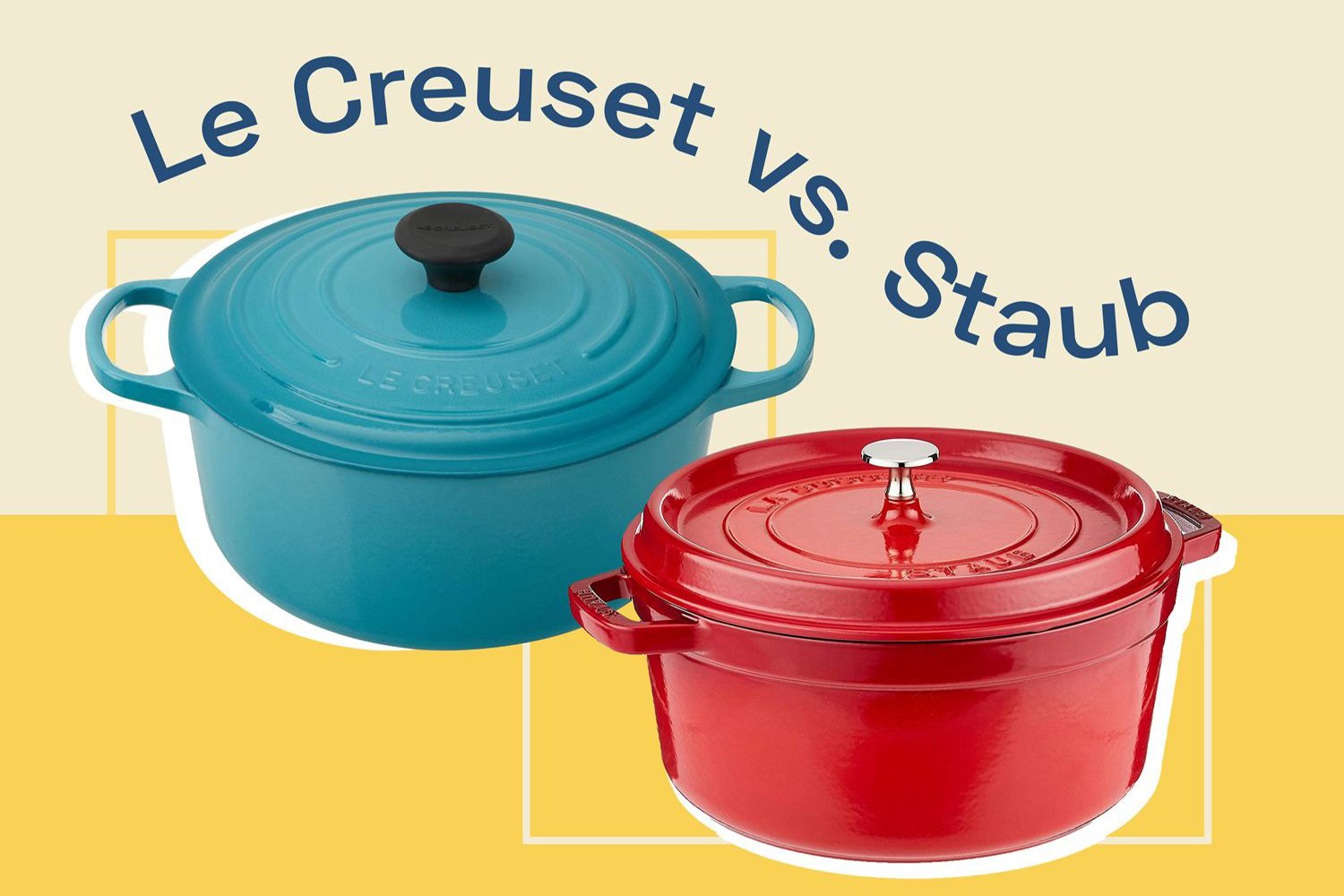

People have strong opinions about this one. Stronger than seems reasonable for a cooking vessel, honestly. But spend enough time in food communities and you’ll find that the Le Creuset vs Staub debate generates a level of conviction that most cookware discussions don’t.
Both brands make enameled cast iron Dutch ovens. Both are French. Both are expensive. Both will outlast you if you take reasonable care of them. The differences between them are real but specific — and knowing what they are will tell you which one belongs in your kitchen.
Two French brands, different origins
Le Creuset has been making enameled cast iron in northern France since 1925. The brand was built on a single foundational product — the Dutch oven, called a cocotte in French — and expanded from there. The iconic Flame orange color has been in continuous production since the beginning. The brand built its American reputation through decades of retail presence and the kind of multigenerational ownership that turns cookware into family heirlooms.
Staub came later. Francis Staub founded the company in Alsace in 1974, and the brand’s early focus was on professional restaurant supply rather than consumer retail. Staub found its way into serious French restaurant kitchens through performance, and the consumer business grew from that reputation. SEB Group acquired Staub in 2008 — the same company that owns Le Creuset, which is one of those corporate footnotes that surprises people when they first hear it.
The lid difference
This is the most important functional distinction between the two brands and it doesn’t get enough attention in casual comparisons.
Staub’s Dutch oven lids have small spikes on the underside — the company calls them self-basting spikes. As moisture rises during cooking, it condenses on the lid, collects on the spikes, and drips back down onto the food below. The dripping pattern is relatively even across the surface.
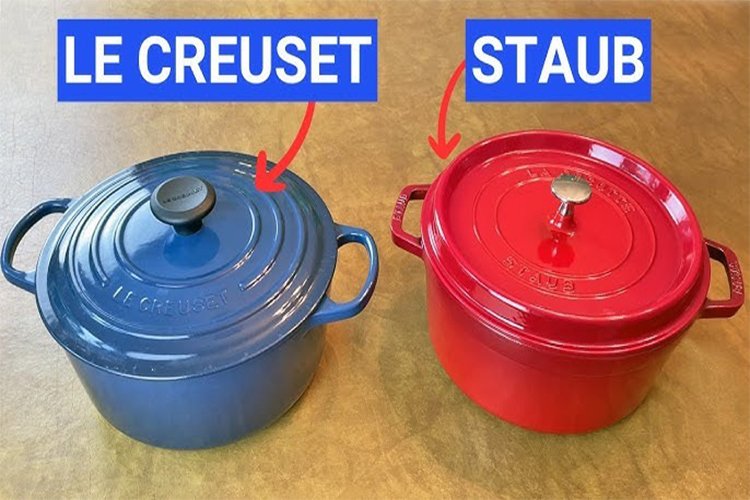
Le Creuset lids are smooth on the inside. Condensation forms and runs to the rim rather than dripping back evenly onto the food.
In a long braise this difference is perceptible. Staub’s self-basting action keeps the top of whatever you’re cooking moister throughout the process. In a three-hour braise of short ribs or a whole chicken, this shows up in the texture of the finished dish — particularly the parts that aren’t fully submerged in braising liquid.
For soups and stews where everything is well submerged, the difference is minimal. For braises where moisture retention on exposed surfaces matters, Staub has an advantage.
Interior enamel color
Le Creuset uses a light-colored enamel interior — cream in most collections, occasionally lighter. Staub uses matte black.
The black interior develops a patina over time as you cook with it. It’s a subtle version of the seasoning process that raw cast iron goes through — oils and cooking residue build up and gradually improve the surface’s natural release properties. The black color also hides staining completely, which becomes relevant after years of cooking tomato-based dishes, red wine braises, and anything else that marks a surface.
Le Creuset’s cream interior shows staining more visibly. Some people find it develops character over time. Others find it a perpetual cleaning frustration that requires specific cleaning products to address. Neither reaction is wrong — they’re different relationships with the same material reality.
The practical trade-off: Staub’s black interior is easier to maintain over the long term and ages without obvious wear. Le Creuset’s lighter interior gives you better visibility of what’s happening on the cooking surface, which matters particularly when you’re building a fond or monitoring browning.
Color and aesthetics
Le Creuset’s color range is broader. Significantly broader. The brand releases seasonal colors, limited editions, and collaborations that have turned some discontinued shades into secondary market items. Flame, Marseille, Cerise, Sage, Provence, Caribbean — the range is extensive and consistently updated.
Staub’s palette is darker and more restrained. Deep blues, graphite, cherry red that reads richer and less bright than Le Creuset’s version. Grenadine rather than Flame. The pieces look like serious professional equipment, which is exactly the aesthetic they’re going for.
If matching a specific kitchen color scheme matters to you, Le Creuset gives you more options. If you prefer cookware that looks like it belongs in a professional kitchen rather than a design-forward home, Staub’s palette is better suited.
Heat performance
Both are cast iron, both are enameled, both perform in the same fundamental way — slow to heat, slow to cool, excellent at maintaining stable temperature once up to temperature. These are the properties that make cast iron Dutch ovens valuable for braising and slow cooking in the first place.
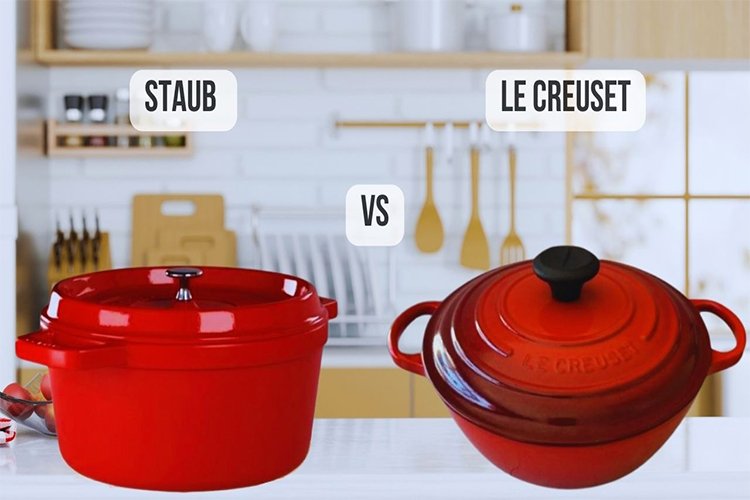
Any performance differences between Le Creuset and Staub in actual cooking are marginal and mostly attributable to the lid design described above rather than the cast iron itself. The cast iron is the cast iron.
Both are oven safe to high temperatures. Both work on all stovetop types including induction.
Weight
Cast iron is heavy. This is not brand-specific — it’s the material. A full-size Le Creuset or Staub Dutch oven loaded with a braise weighs enough that it requires two hands and some attention.
Le Creuset’s handles are slightly larger and some people find them easier to grip with oven mitts. Staub’s handles are more compact. Neither is dramatically more manageable than the other at the same size.
If weight is a concern — wrist problems, shoulder issues, cooking for someone who may have difficulty with heavy pots — this is worth thinking about before buying either brand. The solution is buying a smaller size rather than choosing a different brand.
Price
Staub runs slightly less expensive than Le Creuset at comparable sizes and configurations. The gap varies and changes with sales, but Staub is generally the better value of the two on a purely functional basis.
Le Creuset commands its premium through brand recognition, the broader color range, and fifty additional years of American market presence. For buyers who specifically want a particular Le Creuset color that Staub doesn’t offer, that premium is unavoidable.
The actual answer
Buy Staub if you braise regularly and want the self-basting lid to do its job on long cooks. The black interior that ages well is a practical advantage. The price is slightly lower. The professional aesthetic is appealing to a particular kind of cook.
Buy Le Creuset if color matters to you and you want access to a range that Staub can’t match. If you grew up with Le Creuset in your family’s kitchen and want to continue that. If you want the brand with the longer American track record and wider retail availability.
Both will cook identically for the vast majority of things you put in them. The choice comes down to the lid design, the interior enamel, and the aesthetics — which are all real differences, just not enormous ones.