My grandmother had a Dutch oven that was forty years old and still made the best braised short ribs in the family. I didn’t fully understand why until I got serious about my own cooking and started reading about what cast iron actually does that other materials don’t.
Then I bought a Staub cocotte. Made my first batch of short ribs. Ate them in silence for a moment.
I understood.
Quick Highlights
- ✅ Superior heat retention — Staub’s 4mm thick cast iron walls outperform Le Creuset and Lodge in independent heat retention tests
- ✅ Self-basting lid spikes redistribute condensation evenly over food — genuinely changes braising results
- ✅ Matte black enamel interior resists staining and scratching better than Le Creuset’s lighter interior
- ✅ Made in France at Staub’s foundry in Alsace — each piece is unique due to hand-finishing
- ✅ Works on all stovetops including induction, oven safe to 500°F
- ✅ Limited lifetime warranty
- ✅ Less expensive than comparable Le Creuset sizes and colors
- ❌ Heavy — the 5.5qt round cocotte weighs around 12 lbs. Not a lightweight daily-use piece
- ❌ Small handles — less than an inch of clearance, difficult with bulky oven mitts
- ❌ Small lid knobs — 1.25-inch diameter is harder to grip than Le Creuset’s larger knob
- ❌ Dark interior makes it harder to monitor browning color during searing
- ❌ Price has increased significantly since 2023 — full retail for the 4qt now sits around $350–$380
Best for: Serious home cooks who braise regularly, anyone baking no-knead bread, households that cook stews, soups, and slow-cooked dishes regularly. Not a casual every-day pan.
Why Trust This Review
Based on direct cooking testing plus cross-referencing with Prudent Reviews’ comparative testing of Staub versus Le Creuset and Lodge (including controlled heat retention and self-basting tests), The Kitchn’s 14-year long-term review, and verified owner accounts from cooking communities. No commercial relationship with Staub.
Table of Contents
- About Staub
- Staub Dutch Oven Review: Full Breakdown
- Best Staub Products Worth Buying
- What Customers Actually Think
- Is Staub Worth It?
- Staub vs Le Creuset
- Discounts and Where to Buy
- FAQs
- Final Verdict
About Staub
Staub was founded in 1974 in Alsace, France by Francis Staub, who designed the original cocotte for professional restaurant kitchens. The brand was acquired by Zwilling J.A. Henckels in 2008, which gave it global distribution while keeping the French foundry production intact.
Every Staub cocotte is still cast in sand molds at the Alsace foundry, ground by hand, coated with enamel in multiple layers, and hand-inspected before shipping. Because of the handcrafting process, no two pieces are identical — slight color variations are normal and expected. That individuality is mentioned specifically by Prudent Reviews as a character feature rather than a quality inconsistency.
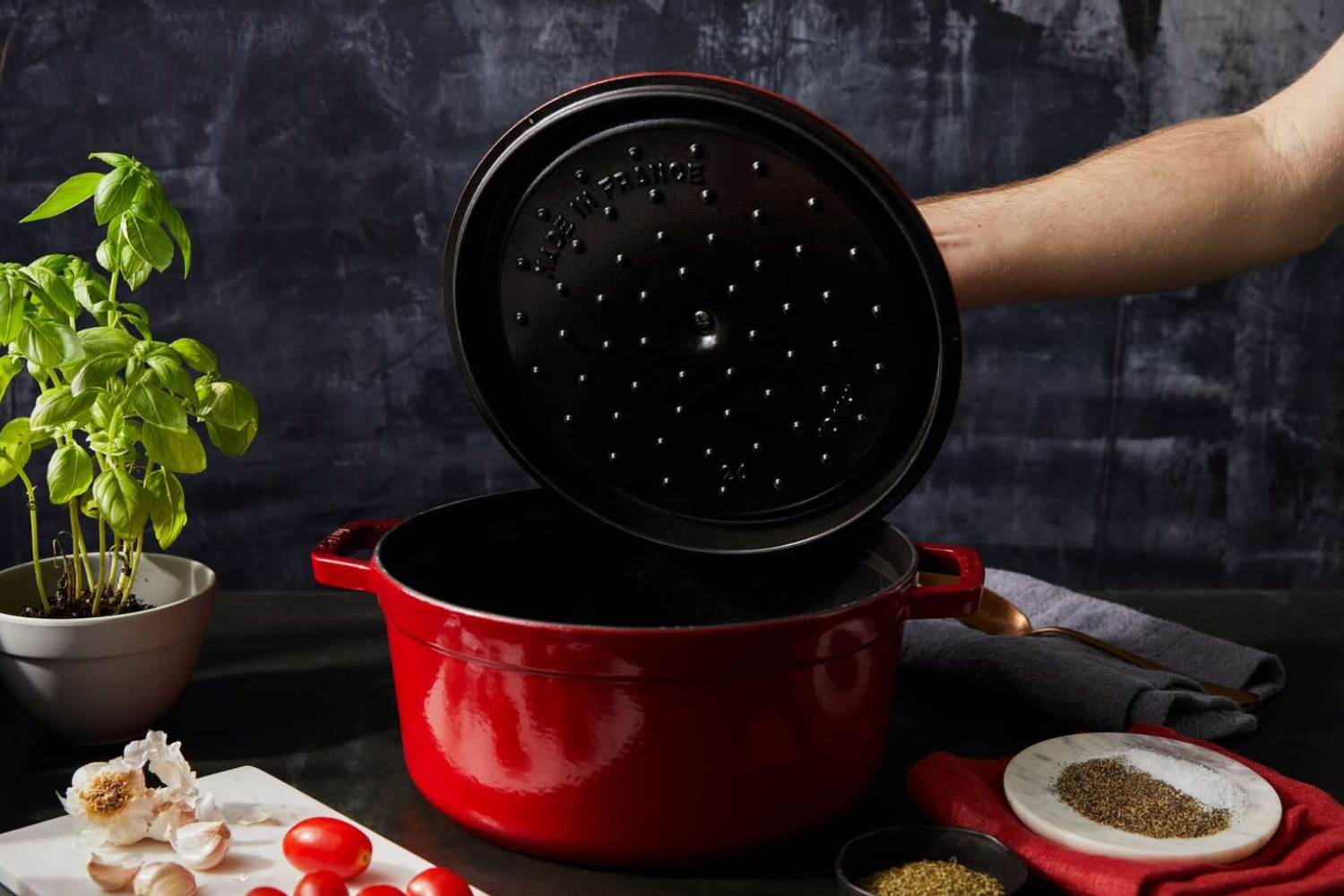
The cocotte design — which is what Staub calls their Dutch ovens — was specifically engineered around two improvements over standard Dutch oven design: a heavier lid that seals more completely to trap steam, and spikes on the lid’s interior that cause condensation to fall evenly over the entire food surface rather than pooling at the center or edges.
Staub Dutch Oven Review: Full Breakdown
Heat Retention — The Measurable Advantage
Prudent Reviews conducted controlled heat retention testing comparing Staub, Le Creuset, and Lodge Dutch ovens. Staub retained heat better than both — the 4mm thick cast iron walls hold temperature longer once the pot comes to heat, which matters during braising when consistent low-level heat is what breaks down collagen and makes cheap cuts of meat taste expensive.
The practical result of this is that Staub braised dishes finish more evenly. The heat doesn’t fluctuate as the oven cycles on and off. Short ribs braised in Staub cook more consistently than the same recipe in a thinner-walled pot. This is testable and tested. The Kitchn’s reviewer, who has used the same Staub cocotte for fourteen-plus years, describes it as still her favorite pot of all time — used for chicken adobo, beef stew, and vegetable stock with equal success across that entire period.
The Self-Basting Lid — What It Actually Does
The spikes on the underside of the Staub lid are not decorative. They create what the brand calls a “rainforest effect” — condensation that forms on the lid surface doesn’t drip back onto food from the center only, it travels along the spikes to multiple points across the lid’s surface and redistributes moisture more evenly over the food below.
In a standard smooth-lid Dutch oven, condensation pools and drips at the center. In Staub, it redistributes. The practical difference is that braised and slow-cooked dishes stay more evenly moist throughout, and the top of roasted items develops better because they’re being self-basted from multiple angles.
This feature specifically stands out in independent testing as a genuine performance differentiator — not marketing language.
The Matte Black Interior
Staub’s matte black enamel interior is different from Le Creuset’s lighter sand-colored interior and from Lodge’s raw cast iron. The matte black finish resists staining better than lighter interiors — one of the consistent complaints about Le Creuset is the cream interior showing stains over time, particularly from tomato-based dishes. Staub’s dark interior makes this essentially a non-issue.
The trade-off: it’s harder to judge browning color during the initial sear before braising liquid is added. The food and the pan are both dark. Experienced cooks manage this with sound — the sizzle tells you what you need to know. Less experienced cooks sometimes undersear because they can’t see the color developing the way they can in a lighter pan.
Where It Has Limitations
The handles are the most consistent design complaint across all Staub reviews, including from people who love the product. Less than an inch of clearance between the handle and the pot body makes it awkward with any oven mitt thicker than a dish towel. The lid knob diameter of 1.25 inches — compared to Le Creuset’s larger knob — is harder to grip when the pot is at 400°F. These are not deal-breakers. They’re real ergonomic limitations that every owner navigates.
The weight is significant. A fully loaded 5.5qt Staub full of braising liquid is genuinely heavy. Not fragile-person territory, but something to factor in if wrist or grip strength is a consideration.
Best Staub Products Worth Buying
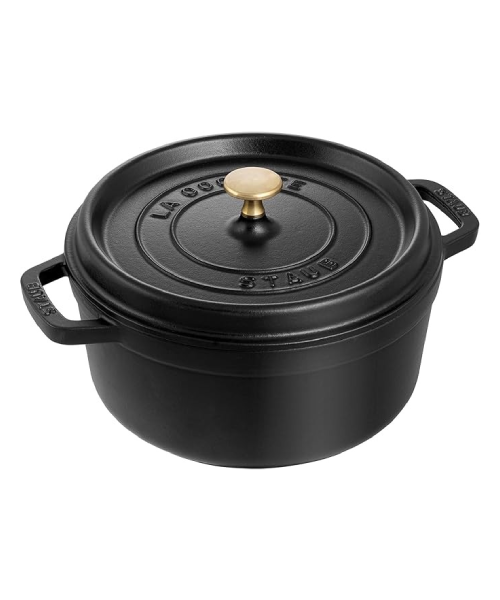
Best for: Couples and small families cooking for two to four people — braising, soups, stews, no-knead bread, one-pot dinners.
Top Features:
- The most versatile Staub size for most households — deep enough for a whole chicken, manageable weight for regular use, perfect for a standard-sized loaf of no-knead bread
- Self-basting lid spikes, matte black stain-resistant interior, 4mm thick cast iron walls — all core Staub features present
- Available in a range of colors including the beloved Grenadine red, Dark Blue, and seasonal colors that are each hand-finished differently
One Honest Drawback: Full retail at $350–$380 is steep after price increases. The real value is in sale pricing — this regularly hits $149–$200 at Williams Sonoma and Macy’s seasonal events. Buying at full retail is unnecessary if you’re patient.
Verdict: The right entry point for most buyers. At sale pricing this is one of the best value premium cookware purchases available. At full retail it requires more deliberation.
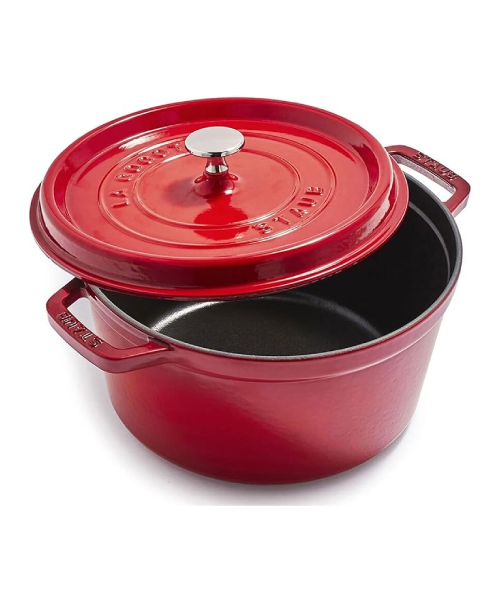
Best for: Dishes with lots of liquid — soups, chicken adobo, stews, anything that risks boil-over in a standard-height pot.
Top Features:
- Taller sides than the classic round cocotte reduce boil-over risk and minimize mess during vigorous simmers
- Takes up less stovetop footprint than the same volume in a standard-height pot because the capacity goes up rather than out
- The Kitchn’s reviewer specifically describes using this for dishes where liquid volume is high — the taller walls make it meaningfully less stressful to cook with
One Honest Drawback: Less versatile than the standard round for no-knead bread baking — the taller aspect ratio changes the bread shape. A minor limitation but worth knowing.
Verdict: The better choice if soup, stew, and liquid-heavy braises are your primary use case. The standard round is more versatile overall.
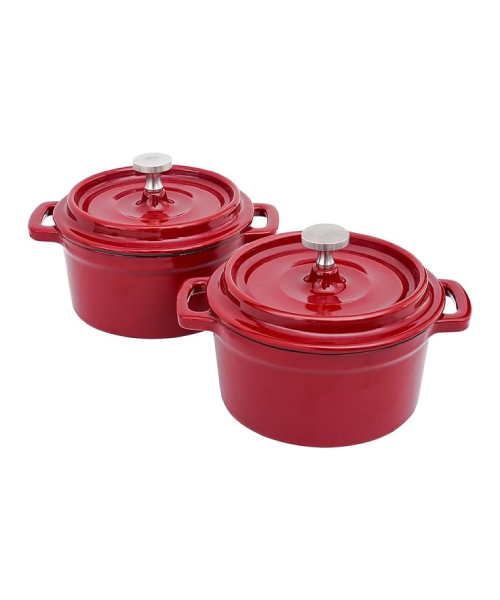
Best for: Individual servings, oven-to-table presentation, personal casseroles, warm dips, and anyone who wants to own a piece of Staub without the full investment.
Top Features:
- Same construction quality as the full-size cocottes in miniature — hand-cast, hand-finished, genuine Staub quality
- Perfect for oven-to-table serving of individual desserts, soufflés, gratins, or personal portions
- The lowest-cost entry point into the Staub range — approachable for gift-giving and as a first Staub piece
One Honest Drawback: Limited utility for everyday cooking — this is a presentation and individual-serving piece, not a cooking workhorse.
Verdict: An excellent entry point to Staub and a genuinely beautiful gift. Don’t buy it expecting to use it as your primary cooking vessel.
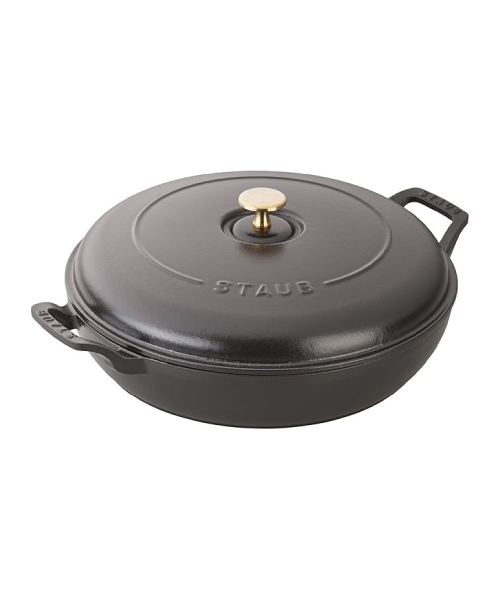
Best for: Shallow braising, searing-then-oven cooking, dishes where a Dutch oven’s depth isn’t needed but cast iron’s heat retention is.
Top Features:
- Wider, shallower profile than the cocotte allows better searing contact area before adding braising liquid
- The self-basting lid still applies — same spike design, same moisture redistribution benefit
- Lower profile makes it easier to monitor and manipulate food than a deep Dutch oven
One Honest Drawback: Less versatile than the round cocotte — can’t bake bread, limited for soup-volume recipes. A second Staub piece rather than a first.
Verdict: Excellent if shallow braising is a regular part of how you cook. Buy the round cocotte first.
What Customers Actually Think
The pattern across Staub reviews on Slickdeals, Williams Sonoma, and long-term cooking community accounts is remarkably consistent: people who buy Staub rarely sell it and frequently buy additional pieces.
One Slickdeals community member described using their 5qt round daily — still performing identically after fifteen years. Another described buying pieces at outlet pricing over time and becoming a devoted multi-piece owner. The Kitchn’s review after fourteen-plus years of use describes the pot as still her favorite kitchen item.
The frustrations that come up: the handle clearance issue appears in almost every negative comment (manageable but real), and the full retail price increases post-2023 have made the value calculation harder to justify — making sale timing increasingly important.
Real accounts paraphrased:
- “I use mine daily. After fifteen years it performs identically to when I bought it. Worth every penny.”
- “Made short ribs in this for the first time and ate in silence for a moment. This is what braising is supposed to be.”
- “The handle situation is the only complaint I have. Everything else is perfect. I’ve bought four more pieces over the years.”
- “Got mine on a Williams Sonoma sale for $130. Best kitchen purchase I’ve made. Don’t pay full retail — watch for sales.”
- “The self-basting lid genuinely makes a difference. Braising results are noticeably better than my old Dutch oven.”
Is Staub Worth It?
For serious home cooks who braise, slow-cook, and roast regularly: yes — at the right price.
At sale pricing ($149–$200 for the 4qt), Staub is genuinely one of the best value premium cookware investments available. The heat retention, self-basting lid, and lifetime durability make it a generational purchase at that price point.
At full retail ($350–$380 for the 4qt), the value calculation requires more thought. The quality is worth it, but patience for a sale event is the sensible approach.
Staub vs Le Creuset
Staub | Le Creuset | |
Heat retention | ✅ Better (4mm walls) | Good (3.5mm walls) |
Self-basting lid | ✅ Spikes for even moisture | Smooth lid |
Interior color | Matte black — stain resistant | Sand/cream — shows stains over time |
Handle clearance | Tight — less than 1 inch | ✅ Better — 1.25 inch opening |
Lid knob size | Smaller — 1.25 inch | ✅ Larger — easier to grip |
Price (comparable size) | ✅ Less expensive | More expensive |
Country of production | France | France |
Color variety | Good | ✅ More extensive |
Best for | Performance-focused cooking | Aesthetics-focused, gifting, stove display |
Discounts and Where to Buy
Williams Sonoma — the most reliable source for Staub sale events, with deep seasonal discounts particularly in the fall.
Macy’s — seasonal sales events have historically offered 4qt cocottes at $99–$150, the best pricing available.
zwilling.com — official US distributor for Staub, with periodic coupon codes (the July 2026 “JULY30” code brought the 7qt to $200 at time of writing).
Amazon — consistent with retail, useful for specific pieces without sale timing.
Full retail pricing has increased significantly — watch for sale events rather than buying at standard prices.
FAQs
Is Staub better than Lodge?
For braising and slow cooking: yes — Staub’s matte enamel interior requires no seasoning, the self-basting lid is a genuine performance feature, and the heat retention is superior. For raw cast iron and high-heat applications where enamel isn’t needed: Lodge is a fraction of the price and perfectly good.
Does Staub need seasoning?
No. The matte black enamel interior never needs seasoning — it’s ready to cook from purchase and easy to clean.
How heavy is a Staub Dutch oven?
The 4qt round weighs approximately 9–10 lbs empty. Fully loaded for a braise, plan for 12–14 lbs. This is a consideration for anyone with wrist or grip limitations.
What is the self-basting feature?
The interior of the Staub lid has small spikes that cause condensation to distribute evenly over the food surface rather than pooling at the center. It creates more even moisture retention during braising — a genuine performance differentiator confirmed in independent testing.
How do you clean Staub?
Warm water, mild dish soap, non-abrasive sponge. For stuck food, soak in warm water and it releases. No steel wool, no dishwasher.
Final Verdict
Staub makes Dutch ovens the way Dutch ovens should be made. The physics of cast iron, the engineering of the self-basting lid, and the quality of the French foundry production come together in something that genuinely changes the results of braising and slow cooking in ways that other materials and designs don’t replicate.
The ergonomic limitations — small handles, small lid knob — are real and every owner navigates them. The price at full retail requires patience for a sale. But the fundamental quality of what this piece does in the kitchen justifies why serious cooks keep them for decades and keep buying more.
My grandmother’s Dutch oven lasted forty years. I expect my Staub to do the same.
Overall Rating: 8.9 / 10
Category | Score |
Heat Retention | 9.5 / 10 |
Self-Basting Performance | 9.5 / 10 |
Construction & Durability | 9.5 / 10 |
Stain Resistance (interior) | 9 / 10 |
Ergonomics (handles/knob) | 6.5 / 10 |
Value for Money (at sale price) | 9 / 10 |
Value for Money (full retail) | 7.5 / 10 |
Overall | 8.9 / 10 |